When homeowners look at a small bathroom, the instinct is often to reach for the brightest white or the simplest neutral in an attempt to “open up” the space. We are taught that light colors reflect light and dark colors absorb it, leading many to believe that a tiny powder room or a cramped ensuite is a puzzle that can only be solved with a bucket of Snow White paint. However, the psychology and physics of color in a confined environment are far more complex than a simple light-versus-dark binary. In reality, some of the most common “safe” choices can actually backfire, making a room feel clinical, shadowy, or even more claustrophobic than it was to begin with. Understanding how light interacts with specific pigments is the first step to making a choice that brings character and a sense of intentionality to your home. It is often through these subtle design shifts that you can truly reimagine your bathroom and turn a cramped utility space into a cozy, stylish sanctuary that feels like a curated part of your home rather than an afterthought.
The Myth of the Stark White Sanctuary
While it seems counterintuitive, painting a small bathroom in a brilliant, stark white can often make the room feel smaller and more uncomfortable.
Stark whites are notoriously unforgiving because they rely heavily on natural light to look their best. In a small bathroom, which often lacks large windows or any windows at all, pure white paint has nothing to reflect. Instead of feeling airy, the walls can take on a grayish, dingy tone as they catch the shadows from corners and fixtures. This “hospital-grade” aesthetic creates a clinical atmosphere that feels cold rather than clean. If you are struggling with a layout that feels cramped regardless of the paint, visiting www.northeasthomeservice.com can inspire structural changes that go beyond mere aesthetics. When you strip away all warmth, every imperfection in the drywall and every gap in the caulking becomes magnified, leaving the room feeling unfinished and harsh.
Seeking Warmth in Off-Whites
If you are determined to stay in the white family, the secret lies in the undertones. Designers suggest moving away from “refrigerator white” and opting for soft ivories, creams, or vanillas. These shades possess a hint of yellow or pink that mimics the glow of natural sunlight, even under artificial bulbs. These warmer tones help to soften the transitions between the walls and the ceiling, blurring the harsh lines of a small room and creating a more cohesive, expansive feeling.
The Problem with Flat Finishes
Beyond the color itself, the finish of white paint matters immensely in a small space. A flat or matte white will absorb what little light is available, making the walls feel like they are closing in. If you must go white, a satin or semi-gloss finish can help bounce light around the room, adding a subtle luminosity that prevents the space from feeling like a literal box.
The Gloom of Cold, Flat Grays
Gray has dominated interior design for over a decade, but choosing the wrong shade for a small bathroom can result in a space that feels perpetually cloudy and uninviting.
Cool-toned grays with blue or green undertones are particularly treacherous in small, windowless rooms. Without a significant amount of natural light to bring out the complexity of the pigment, these colors often read as “muddy” or “drab.” Instead of providing a sophisticated backdrop, they can make the bathroom feel like a basement or a concrete bunker. Because bathrooms are filled with hard, cold surfaces like porcelain, chrome, and tile, adding a cold wall color removes any sense of “soul” from the room.
The Rise of “Greige” and Warm Pewter
To avoid the gloomy trap of flat gray, many designers are pivoting toward “greige”, a hybrid of gray and beige. This palette offers the modern sophistication of gray but retains the “human” warmth of tan. By choosing a gray with a red or yellow base, you ensure that the room remains inviting during your morning routine. Warm grays feel intentional and cozy, whereas cool grays often look like an accidental shadow.
Creating Contrast to Define Space
One of the biggest mistakes with gray is a lack of contrast. When the walls, the floor, and the vanity are all the same mid-tone gray, the room loses its definition. In a small bathroom, you need clear lines to help the eye understand the dimensions of the space. Using a darker charcoal on a vanity or a lighter tile on the floor can break up the monotony and prevent the room from feeling like a featureless gray void.
The Heavy Hand of Pitch Black
There is a fine line between a moody, “hotel-chic” bathroom and a room that feels like a dark closet, and pure black often crosses that line.
While “color drenching” with dark hues is a popular trend, using a flat, uniform black in a tiny bathroom can be overwhelming. Black absorbs nearly all visible light, which means it pulls the walls inward visually. Unless the room is styled with incredible lighting and high-end textures, a black bathroom can feel oppressive and heavy. It highlights every junction and corner, drawing the eye to exactly how small the square footage really is.
Navy and Plum as Alternatives
If you crave the drama of a dark room, consider deep navies, forest greens, or rich plums. These colors provide the “moody” atmosphere you desire, but have enough pigment to react to light. A deep navy will still have a sense of depth and movement that flat black lacks, allowing the room to feel “infinite” rather than “enclosed.”
The Importance of Reflective Surfaces
When working with very dark colors, the surrounding materials must do the heavy lifting. Large mirrors, polished brass fixtures, and glossy tiles are essential to break up the darkness. These elements act as “jewelry” for the room, catching the light and ensuring that the dark walls serve as a backdrop for glamour rather than a source of claustrophobia.
The Pressure of Overly Saturated Brights
Vibrant reds, electric blues, and neon yellows might look energetic on a small paint swatch, but they can become physically exhausting when applied to all four walls of a small bathroom.
In a confined space, highly saturated colors “bounce” off one another, intensifying the hue to an almost vibrating level. A bright red that looked cheerful in the store can quickly make a small bathroom feel hot and stressful. Because we use bathrooms for tasks like applying makeup or shaving, these intense colors can also cast unflattering tints on the skin, making it difficult to see clearly in the mirror.
Selecting Muted Earth Tones
You don’t have to give up on color entirely; you simply need to look for “muddy” or “earthy” versions of your favorite shades. Instead of a fire-engine red, try a terracotta or a burnt sienna. Instead of a bright lemon yellow, look for an ochre or a mustard. These muted versions provide the personality of a bold color without the visual “noise” that makes a small room feel chaotic.
Using Color as an Accent
If you truly love a neon or highly saturated shade, consider using it as an accent rather than a primary wall color. A vibrant vanity, a colorful piece of art, or even a bold shower curtain can satisfy the craving for bright color without overwhelming the senses. This allows the small space to breathe while still reflecting your personal style.
The Shiver of Cool Blues and Greens
It is a common misconception that all blues and greens are “spa-like,” but in a small bathroom, cool-toned versions of these colors can feel icy and damp.
Bathrooms are naturally humid and often filled with cold materials, and painting the walls a cool, pale blue can emphasize that “chilly” feeling. If the blue has a heavy gray or white base, it can look “washed out” under LED lighting. Rather than feeling like a relaxing retreat, the room can end up feeling like an unheated swimming pool locker room.
Embracing Teal and Sage
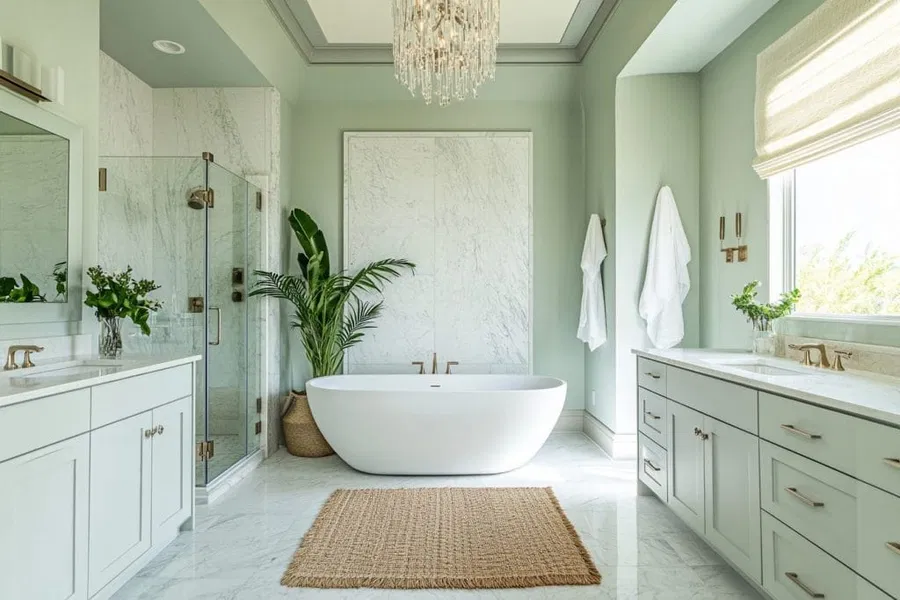
To get the “spa” effect without the “shiver,” look for blues and greens with a hint of warmth. Sage green, for example, contains yellow undertones that make it feel organic and grounded. Teal or aqua has enough vibrancy to feel energetic. These “warmer” versions of cool colors feel much more inviting and “lived-in,” providing a sense of comfort that is essential for a relaxing bathroom environment.
Balancing with Natural Textures
Regardless of the color you choose, small bathrooms benefit immensely from the addition of natural textures. Wood grain, woven baskets, and linen towels can counteract the “hardness” of the room’s surfaces. When paired with a well-chosen, warm-toned paint, these elements work together to create a space that feels intentional, spacious, and undeniably sophisticated.